
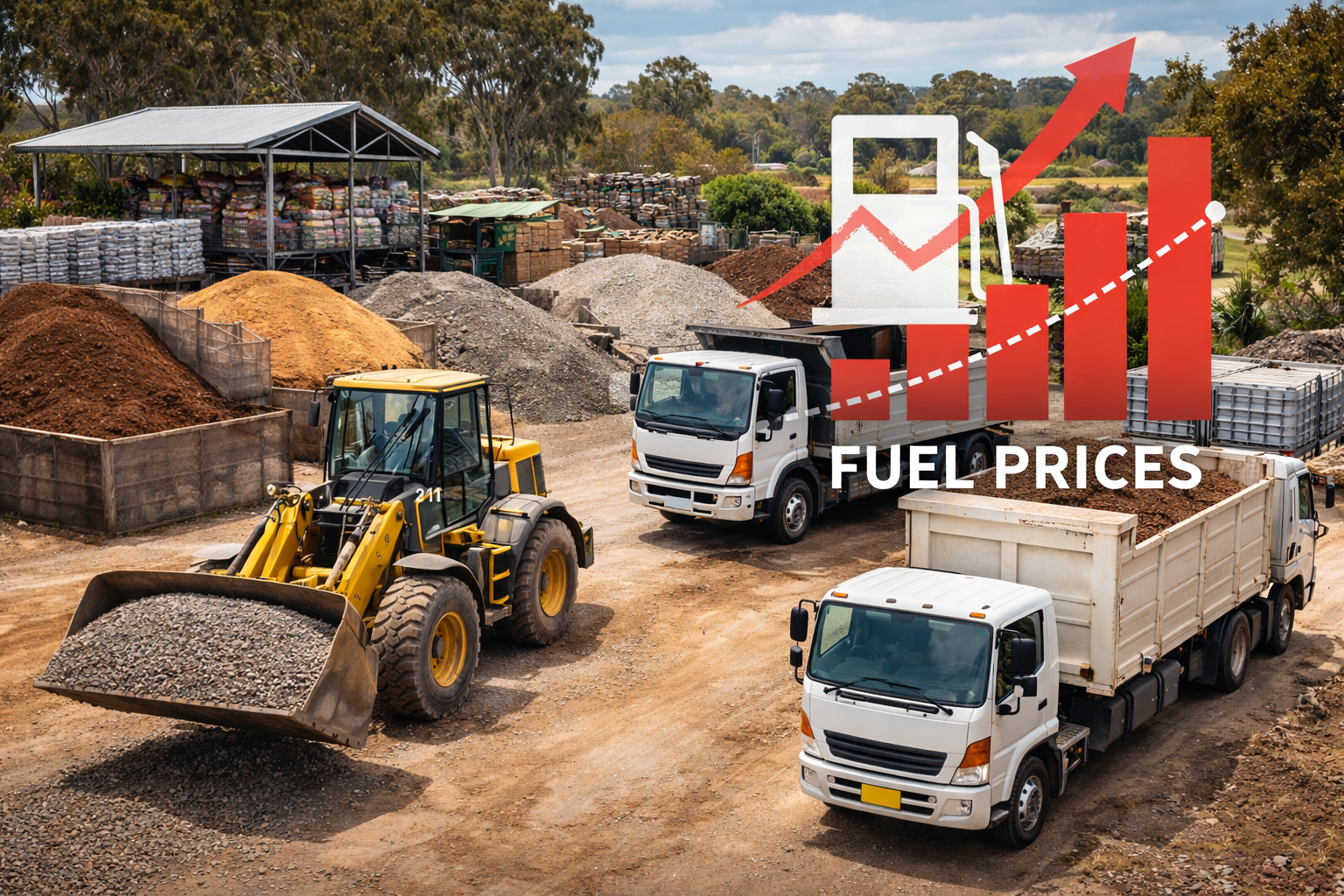
For Australian trade supplies businesses, diesel is not just another overhead. It is built into the cost of getting stock into the yard, moving it between sites, and delivering it to customers.
That matters even more in sectors like landscape and garden supplies, where products such as soil, sand, gravel, mulch and aggregates are heavy, bulky and freight-sensitive. When diesel prices rise, the impact does not stay at the bowser. It flows into supplier invoices, third-party cartage rates, delivery pricing, and margin pressure across the business.
The current global oil backdrop is part of the story. Recent market updates have linked higher fuel costs to Middle East disruption and tighter product markets. In Australia, diesel has been rising sharply, and regional markets have been feeling it too. For landscape yards and other trade suppliers handling heavy goods, that creates a familiar question: how do you recover volatile freight costs without losing visibility of your margins?
Why diesel matters so much for landscape suppliers
Businesses selling bulk materials tend to feel freight pressure faster than many other sectors.
- Inbound freight can materially change the landed cost of stock.
- Outbound deliveries are often essential to the sale, not just an optional extra.
- Margins can be distorted quickly if fuel-driven charges are absorbed inconsistently.
- Manual pricing adjustments are hard to manage when costs move faster than staff can react.
This is especially true for landscape yards operating with mixed sales models: sell by tonne, cubic metre, trailer, bucket, bag or delivered load. In that environment, margin control depends on more than simply updating a sell price. It depends on understanding the real cost of supply and the real value recovered from freight-related charges.
Bulk haulage and cartage costs can quietly erode margin
When diesel rises, transport providers usually respond quickly. Cartage rates, delivery fees, and fuel-related charges can all move upward. For businesses supplying heavy or bulky products, that can create several operational problems at once.
- Supplier freight becomes harder to separate from product base cost.
- Freight changes may not be reflected evenly across stock valuation.
- Customer-facing delivery or levy charges may lag behind actual cost movements.
- Reporting can make freight recovery look healthier or weaker than it really is if data is split across spreadsheets or workarounds.
In other words, the issue is not only that fuel is expensive. The issue is whether your system helps you see, allocate, recover and report on that cost properly.
Why disconnected systems make the problem worse
Many trade suppliers still manage freight impacts through a mix of supplier paperwork, manual charge adjustments, spreadsheet calculations and end-of-month review. That approach can work for a while, but it becomes fragile when fuel is volatile.
Without an integrated operating system, teams often struggle to answer straightforward questions:
- What did that stock really cost once freight was included?
- How much freight have we on-charged this month?
- Are we recovering rising fuel costs consistently on delivered sales?
- Which customers, product lines or delivery types are actually profitable?
For growing landscape yards, irrigation suppliers, rural merchants, building suppliers and other bulk-goods operators, that lack of visibility can turn freight from a known cost into a margin leak.
How ProfiitPlus helps businesses handle freight cost pressure
ProfiitPlus is designed for Australian trade supplies businesses that need purchasing, stock control, invoicing and accounting working together in one system. For freight-sensitive sectors like landscape and garden supplies, that matters because fuel and cartage costs affect both stock valuation and customer billing.
Here are four practical ways ProfiitPlus can help.
1. Freight apportionment for domestic purchases
Freight should not disappear into a rough average or sit outside stock costing if it materially affects product margin. ProfiitPlus can support freight apportionment across domestic purchases so transport costs, fuel levies and related charges can be distributed across purchased goods rather than treated as disconnected overhead.
That helps businesses maintain clearer visibility over base cost versus freight-affected cost, while supporting more meaningful standard and average freight-related cost tracking. In practice, that means a more realistic landed view of stock and better-informed pricing decisions when supplier transport costs move.
2. Variable fuel levy on-charge at invoicing
When diesel is changing quickly, many suppliers need more flexibility than a fixed delivery charge. A fuel levy feature can make that recovery process more responsive by allowing a variable fuel levy to be on-charged to customers at the time of invoicing.
That is important for businesses where delivery economics shift week to week. Instead of relying on staff memory or ad hoc price adjustments, the process becomes more structured, more consistent, and easier to explain commercially.
3. Detailed reporting on freight cost versus freight recovered
One of the biggest challenges with freight is not just charging it. It is understanding whether the business is recovering enough of it.
With stronger freight reporting, businesses can review freight costs incurred, freight amounts on-charged, and the gap between the two. That makes it easier to spot patterns such as under-recovery on certain delivery types, customer groups, branches or product categories.
For operators handling bulk goods, that kind of visibility can be the difference between “sales are up” and “profit is actually improving”.
4. Integrated GL visibility into profitability
Freight decisions should not live in isolation from financial reporting. Because ProfiitPlus includes integrated accounting and General Ledger capability, businesses can connect operational activity to profitability reporting more directly.
That becomes even more useful when reviewing a profit & loss statement by the dimensions that matter to the business. Instead of trying to reconcile disconnected operational reports and external accounts data, managers can work from a more connected view of revenue, cost recovery and margin performance.
Why this matters beyond landscape yards
Landscape suppliers may feel freight pressure acutely because of heavy and bulky products, but they are not alone. Similar issues show up across building materials, irrigation and pumping, rural supplies, industrial products, and other trade-supply sectors where cartage is a meaningful part of cost-to-serve.
That is why the real issue is broader than fuel. It is about operational control.
Businesses that can apportion inbound freight accurately, recover variable outbound costs more consistently, and report on profitability with confidence are in a much better position than businesses relying on disconnected processes.
Better control starts with better visibility
Diesel prices may be driven by international events, but the commercial consequences are local and immediate. In Australia’s trade supplies market, especially in freight-heavy sectors, small errors in cost allocation or charge recovery can scale into large margin problems over time.
For businesses selling bulk materials, this is where the right ERP matters. A system built for trade supplies can help turn freight from a reactive headache into something measurable, manageable and commercially defensible.
If your business is buying by one measure, selling by another, coordinating deliveries, and trying to preserve margin while fuel stays volatile, software capability matters. That is one reason Foresiight continues to invest in solutions for sectors such as landscape and garden supplies, where stock, pricing, freight and service all need to stay aligned.
Want better control over freight, fuel recovery and margin?
If rising delivery and cartage costs are making it harder to protect margin, it may be time to review whether your systems are giving you the visibility you need.
Explore ProfiitPlus, see how it supports landscape and garden suppliers, or read more about handling mixed-unit bulk materials in our article on selling landscape supplies by weight vs volume.