
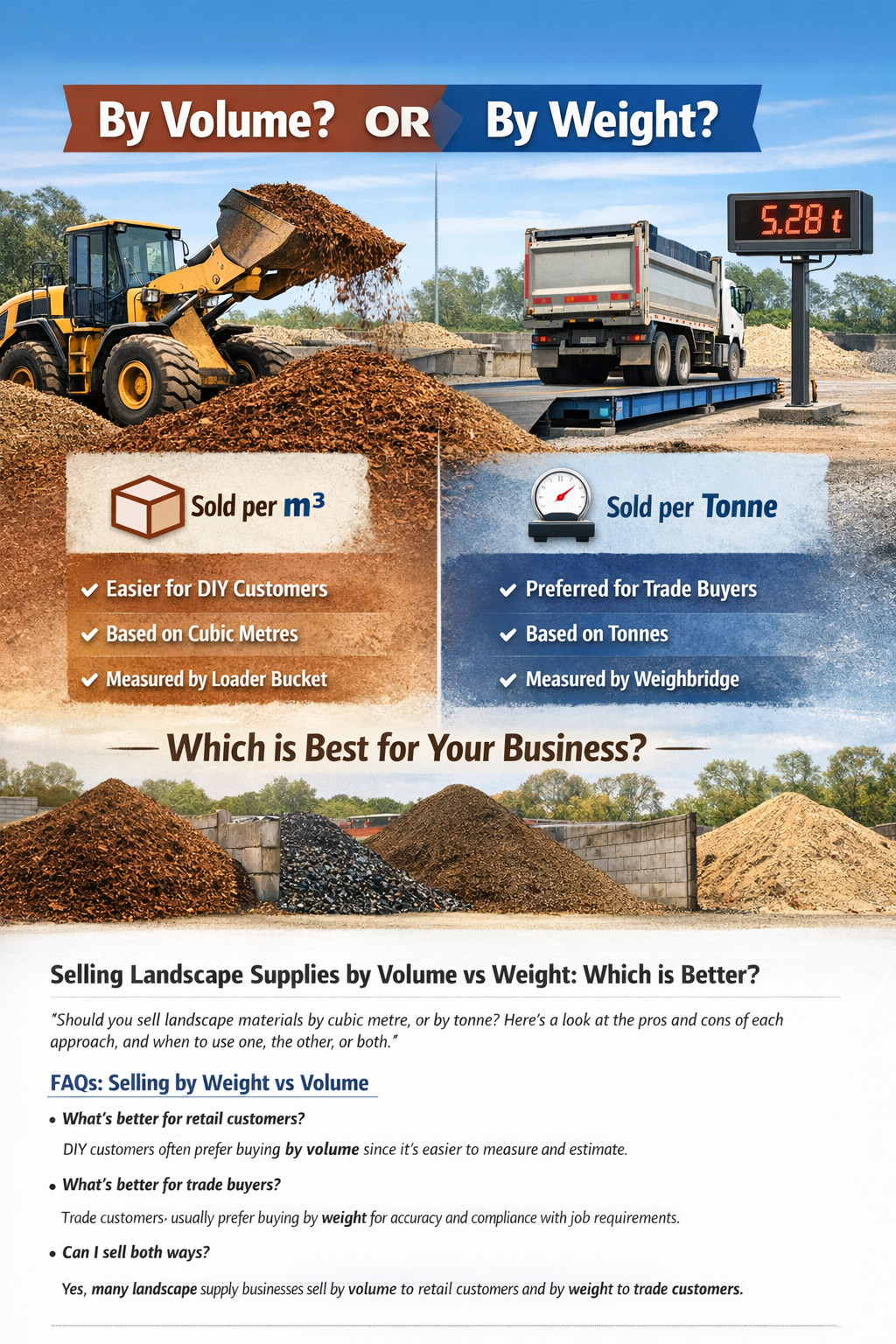
If you sell bulk landscape materials like mulch, soil, sand, gravel and aggregates, there is one decision that quietly touches everything – quoting, invoicing, stock control, delivery scheduling, and customer confidence.
Do you sell by volume (m³) or by weight (tonnes)?
In Australia, loose garden and landscape materials can generally be sold by volume, weight, or lot (for example a bucket load or truckload) depending on how you run your yard and how you communicate the sale. We will link to the official trade measurement guidance later in the article.
Key takeaways
- Volume (m³) feels natural for DIY customers planning a garden bed.
- Weight (tonnes) is often preferred by trade and commercial customers for verification and transport compliance.
- Many successful yards use both – volume for retail, weight for trade.
- Purchasing is often different to selling. It is common to buy from quarries and wholesalers by weight, then sell to retail customers by volume.
- Price breaks matter – smaller quantities often cost more per unit; larger orders should earn a better rate.
- Your POS should make the choice invisible to staff and customers – quoting, pricing tiers, dockets and stock movement should just work.
What does “sell by volume” mean?
Selling by volume means pricing bulk materials in cubic metres (m³) (or in a known bucket or scoop size that represents a consistent volume). This is the language most retail customers use: “I need 1.5 cubes of mulch.”
Pros of selling by volume
- Matches how DIY customers measure projects – garden beds are planned in length x width x depth.
- Fast quoting at the counter – many customers already know the number of cubes they want.
- Ideal for spreadable products – mulch, soil blends, compost and turf underlay are typically planned by thickness.
- Simple delivery language – many truck and trailer capacities are described in cubes.
Cons of selling by volume
- Perception issues from settling and compaction – a tipped load can look different once it settles.
- Consistency depends on process – if you sell by bucket or scoop, you need clear definitions (struck vs heaped) and consistent loading habits.
- Conversions become a daily question – “how many tonnes is a cube?” The honest answer is: it depends on density and moisture.
What does “sell by weight” mean?
Selling by weight means pricing bulk materials in tonnes (or kilograms), typically supported by a weighbridge or trade-approved scales. This is common in trade and commercial supply because it is easy to verify on dockets and aligns with transport payload limits.
Pros of selling by weight
- Clear, auditable measurement – weight-based dockets are simple to reconcile and defend.
- Works well for heavy aggregates – road base, crusher dust, drainage gravel and other base materials are often quoted in tonnes.
- Aligns with transport compliance – truck limits are weight-based.
Cons of selling by weight
- Retail customers do not think in tonnes – “0.8 tonnes” is harder to visualise than “0.5 m³”.
- Moisture changes weight (and perception) – wet material weighs more; the pile may look smaller even when weight is correct.
- Estimating still starts with dimensions – customers often describe area and depth, even if you sell by weight.
Why many landscape suppliers use both methods
In practice, it is common to support both volume and weight because you are serving two different buying mindsets:
- Retail (DIY) customers: sell by volume because it matches project planning (“I measured my garden bed”).
- Trade and commercial customers: sell by weight because it matches how sites order, spec and reconcile deliveries.
This hybrid approach reduces friction – retail stays simple, trade stays verifiable, and your team is not forced into awkward conversions during every sale.
Purchasing vs selling – why many yards buy by weight but sell by volume
Even if your retail counter is volume-first, your suppliers may not be. It is very common to purchase aggregates and other materials by weight (tonnes) because that is how quarries and transport operators measure and invoice.
Then, on the sales side, you may still want to sell to retail customers by volume (m³) because it matches how they estimate jobs. That creates a real operational need: converting supplier units into sale units without losing visibility of margin or stock.
A good landscape-focused system is designed for this. For example, ProfiitPlus by Foresiight supports selling in multiple units of measure (tonnes, m³, buckets, bags) while keeping stock control and pricing consistent – so you can purchase by weight, sell by volume, and still know exactly where you stand on inventory and profit.
Where price breaks fit in (small-quantity premium vs bulk rate)
Bulk materials have real handling costs. Loading, counter time, invoicing, and yard movement do not scale down neatly just because the customer wants “a little bit”. That is why many yards price with:
- A premium for smaller quantities (reflecting handling time and overhead), and
- A better per-unit rate for larger quantities (reflecting efficiency gains and bigger order value).
The important part is consistency. When price breaks are applied automatically at POS – whether the customer is buying m³ or tonnes – you protect margin, remove guesswork for staff, and build customer trust.
Compliance and governance – do not wing it
If the price is determined by measurement, trade measurement rules apply. If you are selling by weight, ensure your weighing process and equipment are appropriate for trade use, and your dockets and invoices clearly reflect the measurement basis.
For practical guidance, refer to the National Measurement Institute:
How to explain it to customers (simple wording)
- Volume customers: “We sell by cubic metre because it matches how you measure your garden. Tell us the length, width and depth, and we will help estimate.”
- Weight customers: “We sell by tonne because it is verifiable and aligns with transport requirements. Your docket shows the exact weight.”
- Conversions: “Tonnes per cubic metre varies by product and moisture. We can estimate, but it will not be identical every day.”
FAQs: landscape supplies – sell by weight vs volume
Is it better to sell landscape supplies by weight or volume?
It depends on your customers and product mix. Volume (m³) is often easiest for retail customers planning garden projects, while weight (tonnes) is often preferred by trade and commercial buyers for verification and transport compliance. Many yards support both.
Can I purchase by weight and sell by volume?
Yes – this is common. Many suppliers invoice by tonnes, while retail customers prefer ordering in cubic metres. The key is having a reliable way to manage unit conversions, pricing, and stock movement so margin and inventory stay accurate.
How should price breaks work for bulk materials?
Smaller quantities usually carry a higher per-unit price due to handling and transaction costs. Larger quantities should earn a better rate. The cleanest approach is applying price breaks automatically at POS so staff do not have to remember thresholds.
Why do weight-to-volume conversions vary?
Because density and moisture vary by product and conditions. A typical conversion can be useful for estimating, but it will not be exact for every load.
A practical note on systems
Whichever method you choose, the day-to-day reality is that landscape yards often need multiple units of measure (tonnes, m³, buckets, bags) plus consistent pricing across quotes, invoices and POS – often with automated price breaks and strong stock control. That is especially true when you purchase by weight but sell by volume.
If you are evaluating systems built specifically for landscape and garden supplies, ProfiitPlus by Foresiight is designed to support these mixed workflows (buy by weight, sell by volume, or vice versa) with strong stock control and pricing management. You can read more here: