
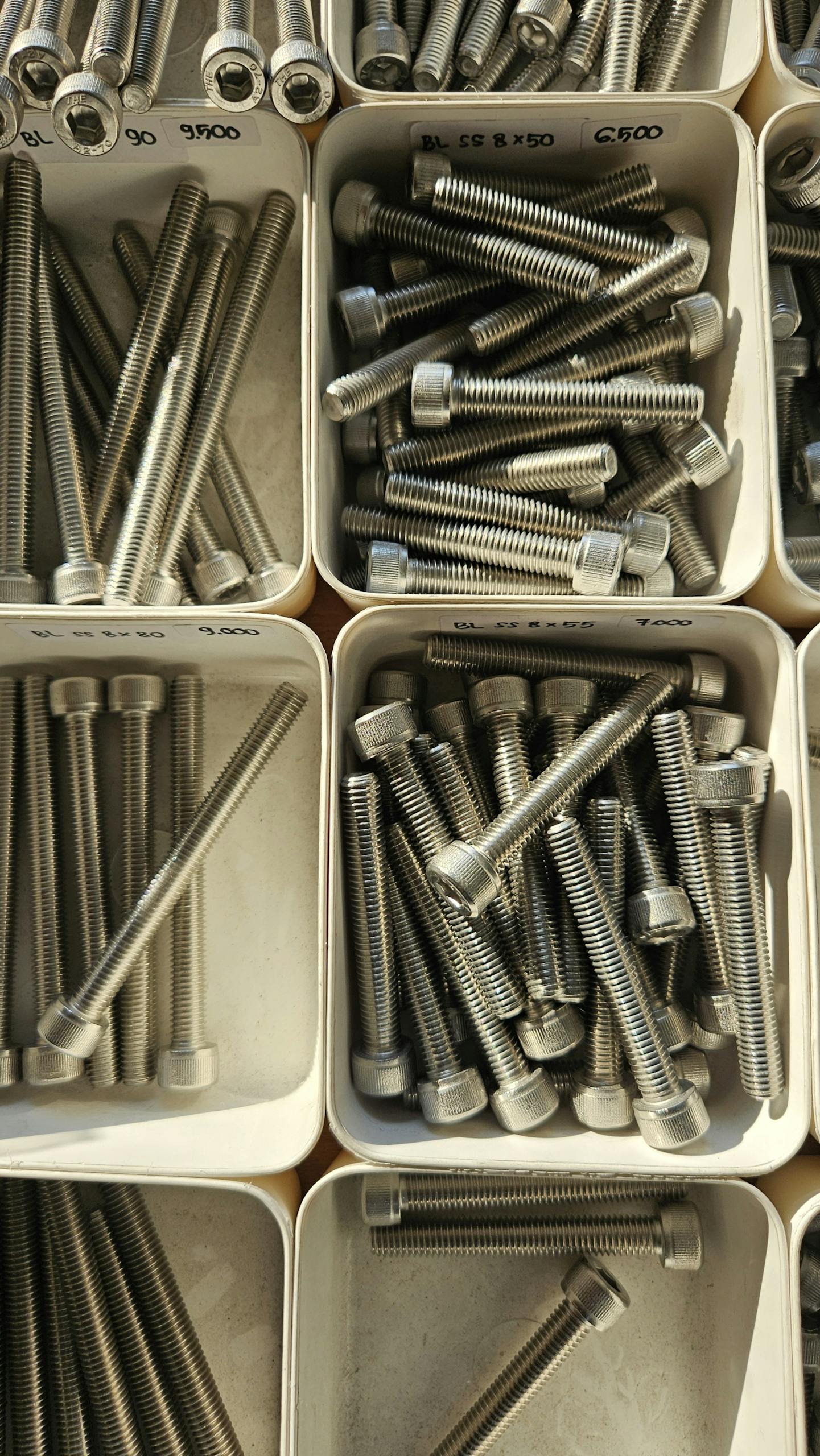
If you run a fasteners business in Australia, you already know the reality: customers expect you to have the exact nut, bolt, screw, anchor, rivet, or threaded rod they need – right now, at the right price, and in the right unit (each, pack, box, or carton). Your range is deep, your SKUs are endless, and even small pricing or stock errors can quickly turn into lost time, lost margin, and lost trust.
The good news is that fasteners can be one of the most predictable, high-turn categories in your business – when your ERP/POS is built for parts-heavy trade supply. With the right setup, you can manage bulk buying versus individual selling, keep margins consistent, and stay on top of replenishment without living in spreadsheets. ProfiitPlus for Tools & Industrial Suppliers is designed for high-SKU environments like fasteners, where speed at the counter and control in the warehouse matter every day.
1) Purchase units vs sell units: stop “pack-break” pain at the source
Fasteners are classic “buy one way, sell multiple ways” products:
- Buy: Box of 100 M8 x 30 hex bolts
- Sell: Each, Pack of 10, or Box
- Keep inventory: accurate at all times, regardless of how it’s sold
This is where ProfiitPlus shines—supporting you to purchase a bulk unit and sell it in smaller units while keeping stock accurate and aligned. If you want a deeper example of this style of setup, see Ratio Items in ProfiitPlus.
Why it matters in fasteners:
- Less duplicate item setup (no “same bolt” created four different ways)
- Clean replenishment and ordering
- Faster counter sales (sell the unit the customer asks for, instantly)
2) Auto-calculating markups: protect margin across packs, singles, and specials
Fasteners pricing often fails in the details:
- Singles get priced too low “to keep it easy”
- Packs get priced inconsistently
- New supplier costs creep in and nobody updates retail
The fix is a pricing process that supports automatic calculations so that when costs change, you keep your pricing logic consistent across unit types and price points – without manual recalculation every time. This is especially important if you sell fasteners in multiple units (each, pack, box), because you want margin protection no matter how the customer buys.
If you’re working in a parts-heavy environment, it’s worth reviewing the broader capability set on ProfiitPlus for Tools & Industrial Suppliers as it’s built for high-SKU, high-transaction businesses.
3) Easy reordering with min’s & max’s: keep the right stock levels without overbuying
Fasteners are a “long tail” category: a handful of lines fly out the door, while thousands of variants move slowly but are still essential. A min/max replenishment approach helps you:
- Maintain availability on high-turn lines (the “always needed” sizes)
- Avoid tying up cash in slow movers
- Order with confidence even when staff change
This ties directly into the fundamentals of strong inventory processes: accurate movements, fewer stockouts, and less dead stock sitting on shelves. For a broader view of stock discipline in similar retail/wholesale environments, see Stock Management for Hardware Stores.
4) Special buy-ins: quote fast, buy smart, and don’t pollute your core stock range
Fastener customers regularly ask for a specific grade, an unusual length, or a one-off quantity for a job. You want to turn these requests into sales quickly – without permanently cluttering your stocked range.
A good workflow supports special buy-ins so you can:
- Create the sale or quote with the right details
- Procure it cleanly from the supplier
- Keep your replenishment range separate from one-off job lines
This is especially helpful when customers treat you like an “on-demand” fastener department – because the system supports the process, not just the transaction.
5) Supplier catalogues: import once, update often, and stop re-keying product data
Fasteners suppliers typically provide product lists in spreadsheets or CSV files with sizes, grades, finishes, pack quantities, barcodes, and costs. When you’re managing thousands of parts, importing supplier catalogues isn’t a “nice to have” – it’s survival.
With extensive catalogue support (including guided import/wizard-style workflows), you can:
- Bring in large ranges quickly
- Standardise data fields and naming conventions
- Refresh costs and range changes without starting from scratch
This is the difference between “we can add a new range this week” and “we’ll get to it… eventually”.
6) Buying groups: keep pricing aligned and purchasing consistent
If you operate within a buying group, you’ll often deal with preferred suppliers, specific item coding or catalogue formats, and negotiated pricing that needs to flow through correctly.
The operational win is consistency:
- Better compliance with group agreements
- Less variance in buying decisions
- Cleaner reporting on supplier performance and range profitability
7) Stock control for 1,000s of parts: speed matters at the counter and in the aisle
Fasteners make search speed and on-hand accuracy non-negotiable. When you have multiple near-identical items and small packaging differences, picking errors and time waste can multiply quickly.
That’s why fastener businesses benefit from:
- Shelf and bin locations
- Fast product search
- Strong barcode workflows
- Reliable stock valuation foundations
Explore how this comes together in a parts-heavy environment on ProfiitPlus for Tools & Industrial Suppliers.
8) Mobile stock control: receive, reorder, label and stocktake without paper
If you want fasteners to run smoothly, your warehouse routines must be simple: receiving stock into the right locations, printing or queuing labels when needed, fast cycle counts, and quick price checks on the floor.
That’s where mobile stock control pays off. StockMate is designed for stocktakes, receiving, purchase orders, and price checks using mobile devices and barcode scanning – so the work happens where the stock is.
Turning fasteners into a predictable profit engine
Fasteners are small items with big consequences. When systems aren’t designed for this category, the pain shows up everywhere: margin leakage, stockouts, counter delays, and messy reordering.
But when you get the fundamentals right – multi-unit selling, consistent markup logic, min/max replenishment, clean special buy-ins, and strong catalogue plus mobile workflows – fasteners become one of the most dependable profit engines in the business.
If you’d like to see how ProfiitPlus is tailored for tools & industrial suppliers (including fasteners), start here: ProfiitPlus for Tools & Industrial Suppliers.
